Key Takeaways
- Tapping is the default for internal threads in pre-drilled holes — simple, fast, and workable at any volume.
- Die threading suits external threads on rods and studs at low to medium volume.
- Thread milling handles large diameters, hard materials, and multiple thread sizes with one CNC tool.
- Thread rolling cold-forms threads with roughly 30–50% higher fatigue strength — the production choice for fasteners under cyclic load.
- Lathe single-point threading is the most flexible route for custom and non-standard threads.
- The comparison table below gives a side-by-side decision reference before we go method by method.
Introduction: Why Threads Matter in Metal Fabrication
Threads fasten, adjust, and transfer force in nearly every mechanical assembly — and how you make them determines the strength, precision, and cost of the finished part. In metal fabrication, five methods dominate: tapping for internal threads, die threading for external threads, thread milling for large or non-standard diameters, thread rolling for high-strength production runs, and lathe single-point threading for custom work.
This guide walks through how each method works, where it excels, where it falls short, and how to choose between them based on your material, production volume, and tolerance requirements.
Quick Comparison: Five Thread Manufacturing Methods
The table below condenses the five methods covered in this guide into a single decision reference. Match your thread location (internal vs external), production volume, and strength requirements against each process before committing to a manufacturing route. For external threads on shafts and fasteners, our CNC turning service handles both single-point threading and die threading in-house.
| Method | Thread Type | Precision & Consistency | Relative Speed | Best For |
|---|---|---|---|---|
| Tapping | Internal | Good — standard 6H-class fits | Fast (seconds per hole) | Blind & through holes, any volume |
| Threading with Dies | External | Good — standard 6g-class fits | Fast | Rods, studs, repair work, low volume |
| Thread Milling | Internal & External | Excellent — one tool cuts multiple pitches & diameters | Moderate | Large diameters, hard materials, flexible pitch requirements |
| Thread Rolling | External | Excellent — cold-formed, highly repeatable | Very fast (high volume) | High-strength fasteners, mass production |
| Lathe Single-Point | External & Internal | Most flexible — custom & non-standard pitches | Slower per part | Custom threads, large or odd sizes, prototypes |
One data point worth highlighting: because thread rolling cold-forms the profile instead of cutting it, the material grain flows continuously around the thread root and gains compressive residual stress. Industry fastener testing consistently shows rolled threads deliver roughly 30–50% higher fatigue strength than cut threads, and a 2025 study presented at the International Conference on Shot Peening measured 113.8 MPa fatigue strength for rolled threads versus 45.1 MPa for cut threads on comparable specimens. If your threaded part sees cyclic loading — vibration, repeated torque, pressure cycling — specify rolled threads for production and verify the fit class on the drawing per our tolerance standards guide.
Tapping: Cutting Internal Threads
Tapping is a revered and traditional method in the world of thread manufacturing, specifically utilized for cutting internal threads. This process, refined over time, is essential for producing the female portion of the thread pairing. It’s not just a matter of carving out space; tapping shapes a profile that must align perfectly with its male counterpart for seamless assembly.
The Process of Tapping
At its simplest, tapping involves a tap—a cutting tool with threads corresponding to those intended for the final product. A tap is carefully aligned with a pre-drilled hole in the metal part, and as it turns, its sharp edges cut into the material to form precise threads. The intricacies of the tap’s design, including the number of flutes or cutting edges and its geometry, play a critical role in managing the chips produced during the cutting, ensuring a clean, accurate thread.
Types of Taps and Their Applications
Taps come in various designs for different applications. Straight-flute taps are the most basic and widely used, especially for hand tapping, but they can be limited in their chip evacuation capacity. Spiral point taps, also known as ‘gun taps,’ push chips ahead to prevent clogging and are ideal for through holes. Spiral flute taps, on the other hand, are designed to pull chips away, making them suitable for blind holes.
Tandem taps combine roughing and finishing operations in a single tool, increasing efficiency in mass production environments. Each type serves a unique purpose, balancing speed, finish quality, and ease of operation based on the application’s demands.
Advantages and Limitations of Tapping
The advantages of tapping are numerous. It’s a relatively straightforward technique that doesn’t require complex machinery, making it accessible and cost-effective. The flexibility of hand tapping allows for threading in tight or difficult-to-reach areas where machines cannot operate.
However, there are limitations. Tapping can be time-consuming, particularly in manual operations, and the quality of threads is highly dependent on the operator’s skill
Best for: internal threads in drilled holes, blind or through, at any volume.
Avoid when: the hole is very large in diameter or the material is too hard for taps — consider thread milling instead.
Threading with Dies: External Threads on Rods and Studs
When it comes to forming external threads, the use of threading dies takes center stage. Like a craftsman’s chisel, a threading die meticulously sculpts the surface of a rod or workpiece into a spiral of peaks and valleys. This method, praised for its precision and efficiency, has become a staple in metal fabrication shops around the globe.
Understanding Threading Dies
A threading die is a tool encased with a series of sharp cutting edges designed to match the profile of the intended thread. The die is placed around the circumference of a cylindrical workpiece and applied with pressure as it rotates, cutting into the metal to carve out the external threads. There are different die configurations, each tailored for specific operations and results.
Varieties of Dies
Split-adjustable dies offer customization for the thread diameter and can be recalibrated for wear, ensuring longevity and consistent accuracy. Solid dies are typically used for their durability and are often preferred for uniform, high-volume threading tasks. There are also self-opening die heads, which can automatically release from the workpiece after completing a threading operation, boosting productivity in automated setups.
Advantages and Limitations of Die Threading
The primary advantage of using threading dies lies in their ability to produce precise and uniformly shaped threads quickly and repeatedly, ideal for large-scale production runs. Dies are relatively easy to use with a wrench or in a machine, allowing for versatility in manufacturing workflows.
On the flip side, dies can become worn over time, which may affect the quality of the threads and necessitate replacement or re-adjustment. Additionally, not all dies are suitable for all materials; harder materials might require specialized or pre-treated dies to avoid damage and ensure a clean cut.
Applications and Best Practices
Threading with dies is well-suited for high-volume production where consistent thread quality is paramount. The process is favored for creating bolts, screws, and other fasteners that require standardized external threads. Best practices include proper alignment of the die with the workpiece, selecting appropriate die materials for the metal being threaded, and ensuring adequate lubrication during operation to minimize friction and wear.
In conclusion, threading with dies remains an integral part of thread manufacturing, providing metal fabricators with a reliable means to produce strong and accurate external threads for a myriad of applications.
Best for: external threads on rods, studs, and repair work at low to medium volume.
Avoid when: you need high-volume output or maximum fatigue strength — thread rolling is the better production route.
Thread Milling: CNC Flexibility for Large and Hard Parts
As the demand for versatility and precision in thread manufacturing escalates, thread milling emerges as a sophisticated solution. This CNC-driven process combines the advantages of controlled machining with the ability to produce threads of varying sizes, pitches, and configurations all on the same machine.
The Technique Behind Thread Milling
Thread milling requires a CNC machine equipped with a cutting tool designed to mill threads into a workpiece. The milling cutter follows a helical path that corresponds to the desired thread profile, engaging the material with a combination of rotary and lateral movements. The precision of CNC programming allows for intricate control over thread dimensions, resulting in high-quality threads with excellent surface finish and dimensional accuracy.
Advantages of CNC Thread Milling
One of the most significant benefits of thread milling is its adaptability. With the right programming, a single machine can produce numerous thread profiles without the need to change tools, saving time and reducing the cost associated with having a large inventory of taps and dies. Thread milling is also known for producing threads with higher strength due to the superior cut surface, and it can be performed on both internal and external surfaces.
Furthermore, thread milling excels when working with tough materials or large, bulky parts where other threading methods might falter. The process also eliminates concerns about chip evacuation, since the CNC machine can be programmed to manage chip size and removal efficiently.
Limitations and Considerations
Despite its many advantages, thread milling is not without limitations. The necessity for CNC equipment means greater initial investment costs and the requirement for skilled operators familiar with programming and machine operation. There is also a limit to the size of threads that can be milled, dictated by the machine’s capabilities and the availability of suitable thread milling cutters.
When to Use Thread Milling
Thread milling is particularly advantageous for applications requiring high precision or where there is a need for threading close to the bottom of a blind hole. It is an excellent choice for specialty threads or when working with materials prone to producing difficult-to-manage chips. The method is further applicable when producing large-diameter threads or when working within tight tolerances is crucial.
In conclusion, thread milling represents a modern, versatile approach to thread manufacturing, bridging the gap between flexibility and precision, making it a valuable technique for contemporary metal fabrication.
Best for: large diameters, hard materials, thin-walled parts, and shops that want one tool for many thread sizes.
Avoid when: cycle time per part matters more than flexibility — tapping or rolling is faster for standard sizes.
Thread Rolling: Cold-Formed Threads for Production
Thread rolling stands out as a powerful force in thread manufacturing that molds metal into threads through a plastic deformation process. Unlike cutting operations, thread rolling reshapes the workpiece material, resulting in threads that are not just formed but forged with strength and durability.
The Fundamentals of Thread Rolling
At the core of thread rolling is a pair of hardened steel dies, containing the negative of the thread form. The workpiece is placed between these dies, which then exert immense pressure, displacing and flowing the metal into the form of the thread. This process generates no cutting waste and results in a work-hardened, smooth-surfaced thread with enhanced resistance to fatigue and shear.
The Thread Rolling Advantage
The advantages of thread rolling are profound, particularly when considering the strength and quality of the product. The cold working effect of rolling strengthens the material by realigning its grain structure along the contour of the threads. This process yields threads that are consistent in quality and possess a high level of fatigue resistance, making them ideal for high-stress applications.
Another hallmark of thread rolling is its efficiency. The process is swift and continuous, capable of producing threads in mere seconds per part. This equates to not only rapid throughput but also a marked reduction in production costs compared to other threading methods.
Limitations and Applications
Thread rolling, however, comes with its set of limitations. It requires ductile materials to accommodate the deformation process, which means harder materials may not be suitable candidates. Moreover, threads can only be rolled up to a certain length and diameter, governed by the capacity of the rolling machines and dies.
Yet, in applications where these constraints are not prohibitive, thread rolling is unparalleled. It is the method of choice for high-volume production runs, like fasteners and automotive components, where cost-effectiveness, thread quality, and speed are paramount.
Precision and Cost at Production Volume
Despite the initial investment in thread rolling machinery and dies, the amortized cost over high production volumes is minimal. And with advancements in control technology, modern thread rolling machines are capable of achieving strict tolerances on par with precisely machined threads.
Whether in the realms of aerospace, automotive, or anywhere robust threaded components are essential, thread rolling delivers performance that not only meets but often exceeds the stringent expectations of these high-demand industries.
In conclusion, thread rolling is a transformative process, a method that not only shapes metal but also tempers and toughens it, creating threads that stand up to the toughest applications with extraordinary proficiency.
Best for: high-volume external threads and fasteners under cyclic load — strongest thread of any method.
Avoid when: you need internal threads, very hard pre-hardened material, or one-off quantities.
Lathe Machining: Single-Point Threading for Custom Work
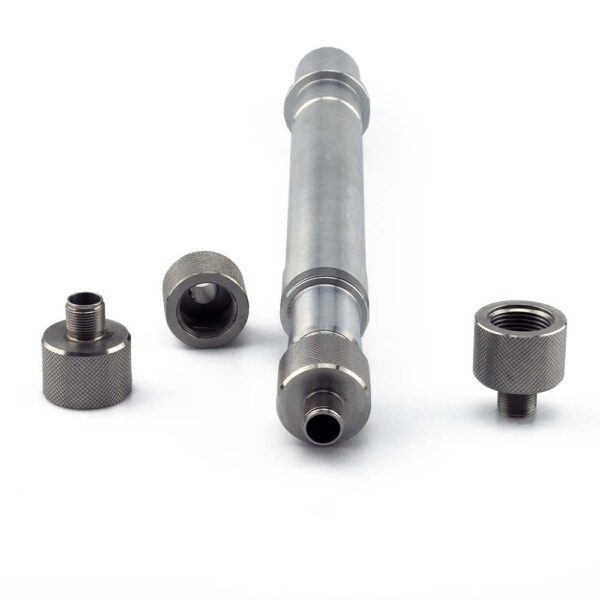
Lathe Machining is a time-honored and fundamental method for creating both internal and external threads, valued for its versatility and precision. By employing a lathe, this traditional technique continues to be indispensable in modern manufacturing when custom or intricate threading is required.
How Lathe Machining Works
In lathe machining, the workpiece is securely clamped and rotated at a consistent speed. A cutting tool, carefully ground to the specific thread profile needed, is then precisely advanced into the workpiece along a predetermined path, commonly guided by the lathe’s lead screw. This cutting action removes material to form the thread’s grooves and peaks in a helical pattern along the workpiece.
Versatility and Control
One of the key advantages of lathe machining is the immense control it offers. Skilled machinists can manipulate the cutting tool path, depth of cut, and feed rate to create threads that meet diverse specifications, including various thread pitches and diameters. The technique is equally adept at cutting threads on the inside of a bore (internal threading), as it is on the outside of a rod or cylinder (external threading).
The flexibility of lathe machining also extends to the fact that almost any workpiece material can be threaded, from soft plastics to hard metals, making it a universally applicable method across industries.
Comparing with Other Methods
Unlike rolling or pressing, where material is deformed, lathe machining removes material, which can be an asset when working with brittle materials. In comparison to tapping and using dies, lathe machining excels in producing custom threads and is not confined by tap or die sizes.
However, lathe machining can be slower than other methods like tapping or rolling, particularly for high-volume production. It also produces cutting waste (in the form of chips), which must be managed and disposed of properly.
Applications for Lathe Machining
Lathe machining is especially valuable for custom or special thread requirements, prototype development, and low-to-medium volume productions where the setup of dedicated thread rolling machines is not economically viable. It’s also preferred for applications demanding high precision, such as in aerospace, custom automotive parts, or specialized industrial machinery.
Where Lathe Threading Fits Today
This classic threading method retains its prominence in the manufacturing realm due to its unwavering ability to produce tailor-made threads with exceptional accuracy. Lathe machining embodies the synthesis of skill, precision, and adaptability, etching its value deeply in the foundation of modern mechanical construction.
In conclusion, lathe machining is a testament to the art of thread crafting, offering the finesse and customization necessary for specialized applications where every thread counts.
Best for: custom, non-standard, large, or low-volume external and internal threads on turned parts.
Avoid when: volume is high and the thread is standard — dedicated methods above are faster per piece.
How to Choose the Right Thread Manufacturing Method
Selecting the appropriate method for thread manufacturing is crucial and can have profound impacts on both the quality of the end product and the efficiency of production. With an array of methods available, the decision must be informed by an understanding of their respective strengths and limitations.
Analyzing Material and Design Specifications
The journey to choose the right method begins with a careful analysis of the material properties and the design specifications of the part. Some materials may be more amenable to thread rolling due to their ductility, while harder materials might be better suited to thread milling or lathe machining where material is cut away.
Design specifications, such as thread diameter, pitch, and tolerance levels, also dictate compatibility with various threading processes. Additionally, the requirement for thread forms like Acme, metric, or pipe threads can influence the selected method.
Consider Production Volume and Costs
High-volume projects often favor methods like thread rolling, where the improved cycle speed and absence of cutting waste result in lower per-unit costs. Conversely, for lower-volume or custom threads, the versatility of lathe machining or thread milling can be more practical, despite their relatively higher setup times and costs.
Weighing the Importance of Quality and Durability
Thread quality is paramount, with factors like surface finish, dimensional accuracy, and thread integrity taking center stage. Threading methods that involve deformation, such as rolling, create threads with enhanced fatigue resistance, making them ideal for high-stress applications. Quality control must also be considered, with some methods making certain types of inspection easier or harder.
Equipment Availability and Expertise
The decision often hinges on the equipment available in a facility and the skill level of the workforce. The necessity of specific machines like CNC mills or thread rollers, and the expertise required to operate such machinery, play into choosing the most feasible method for a given operation.
Making the Best Decision for Your Operation
Ultimately, the choice of thread manufacturing technique balances technical requirements with operational constraints or advantages. Factors like lead times, equipment and tooling costs, desired finish, and workpiece material will guide manufacturers to the most efficient and appropriate method.
In conclusion, choosing the right thread manufacturing method is a strategic process that integrates multiple facets of the manufacturing environment. By considering material suitability, design requirements, production volumes, quality expectations, and available resources, manufacturers can ensure that they invest in the right process to meet their threading needs with precision and efficiency.
Conclusion: Match the Method to the Part
There is no single best way to make a thread — only the best way for a given part. Tapping and die threading cover everyday internal and external work; thread milling buys flexibility and precision on demanding geometry; thread rolling wins on strength and speed at volume; single-point lathe threading handles everything custom. Start from your thread specification, material, and annual volume — the right process usually selects itself. And if you’d rather not make that call alone, send us your drawing: we’ll recommend the most economical threading route as part of a free DFM review.
Need Custom Threaded Parts? Get a CNC Quote
BravoFabs manufactures precision threaded components — tapping, thread milling, single-point turning and rolled-thread sourcing for UN, UNC, metric and custom specifications. Our ISO-certified facility in Dongguan, China delivers tight-tolerance threaded parts with full thread-gauge inspection for industrial clients in Germany, the US, and across Europe.
🔗 Related Manufacturing Services & Articles
- Precision CNC Machining Service — 3-axis & 5-axis milling with tapping & thread milling, full QC reports
- CNC Turning Service — single-point threading, custom shafts, bushings & rotational parts
- 8UN vs UNC Thread: Specifications & Differences — which UN thread series fits your application
- Tolerance Standards: ISO 2768 & ASME Y14.5 Guide — how to specify thread fits on drawings
- QC Inspection Devices for Metal Fabrication — thread gauges and how we verify every batch
Explore Related Manufacturing Services
Precision turned parts. UN, UNC, metric threads.
Precision CNC milling, turning & 5-axis machining.